
What the Middlesex County Owner Record Shows
The Commissioner builds the ownership roll from deeds and other recorded or probate instruments. The public Vision page shows no sample parcel card. Field labels and values therefore require a live lookup. Use the card guide to separate confirmed county search keys from fields that call for inspection.
| Owner entry | Search by name is confirmed; exact result label should be checked live. |
|---|---|
| Mailing address | Target parcel-card field; public static page does not confirm its display label. |
| Situs / E911 address | Address search is confirmed; compare with the physical location. |
| GPIN / parcel ID | County-confirmed search key; Treasurer requires exact spacing. |
| Legal description | Use the recorded deed or plat for its authoritative text. |
| Deed reference and date | Confirm in the Clerk's index; exact Vision display is not verified. |
A roll entry is administrative, not a title opinion. Mailing address and situs answer different questions. One receives notices, while the other locates the land, and a tax-mailing address can sit outside the county or name an entity. When exact current vesting matters, rely on the recorded instrument itself.
Confirm the Current Middlesex County Owner
Compare the Vision roll with the newest deed in the Circuit Court Clerk's land records. That is the practical check after a recent transfer. Recording and roll updates run on separate tracks. No Middlesex office publishes a standard delay in days, so treat none as typical.
- Search Vision by address or GPIN and write down the owner entry and parcel description.
- Search the latest conveyance by party name in SRA/COVERS or at the Clerk's record room.
- Compare the deed's grantee and vesting language with the roll, keeping entity capacity intact.
- If the owner is an LLC or corporation, confirm the filed entity name in the Virginia SCC system.
- Owner of record
- The party shown in the county's ownership administration record.
- Vesting
- The way a deed names the grantee or capacity, such as trustee or entity.
- Registered agent
- The filed service contact shown in an SCC entity record.
Using a Middlesex Owner Record Lawfully
Use a Middlesex owner record for diligence, conveyance checks, and civic research. A roll entry is not proof of use. Do not republish sensitive details from a record. Virginia's remote land-record statute sets two firm rules. It permits only the last four digits of a Social Security number and restricts redistribution of records obtained remotely.
Lawful use. Use owner information only for a legitimate property purpose. Do not use a Middlesex County record to stalk, harass, or target any person.
Middlesex's Owner Roll and Assessment Date
Vision puts the current assessment effective January 1, 2022, holding until the next general reassessment. A 2026 notice describes prep for that coming reassessment. Both facts describe the valuation cycle. Ownership is different, since the Commissioner maintains it from recorded deeds, wills, chancery causes, and special warranty deeds.
Never read the assessment date as an acquisition date. A recorded deed may be newer. Confirm the exact owner-field label and refresh date in the live parcel result. The Commissioner's Real Estate Office answers questions at 804-758-5331.
The public Middlesex Vision portal is the county's assessment entry point.
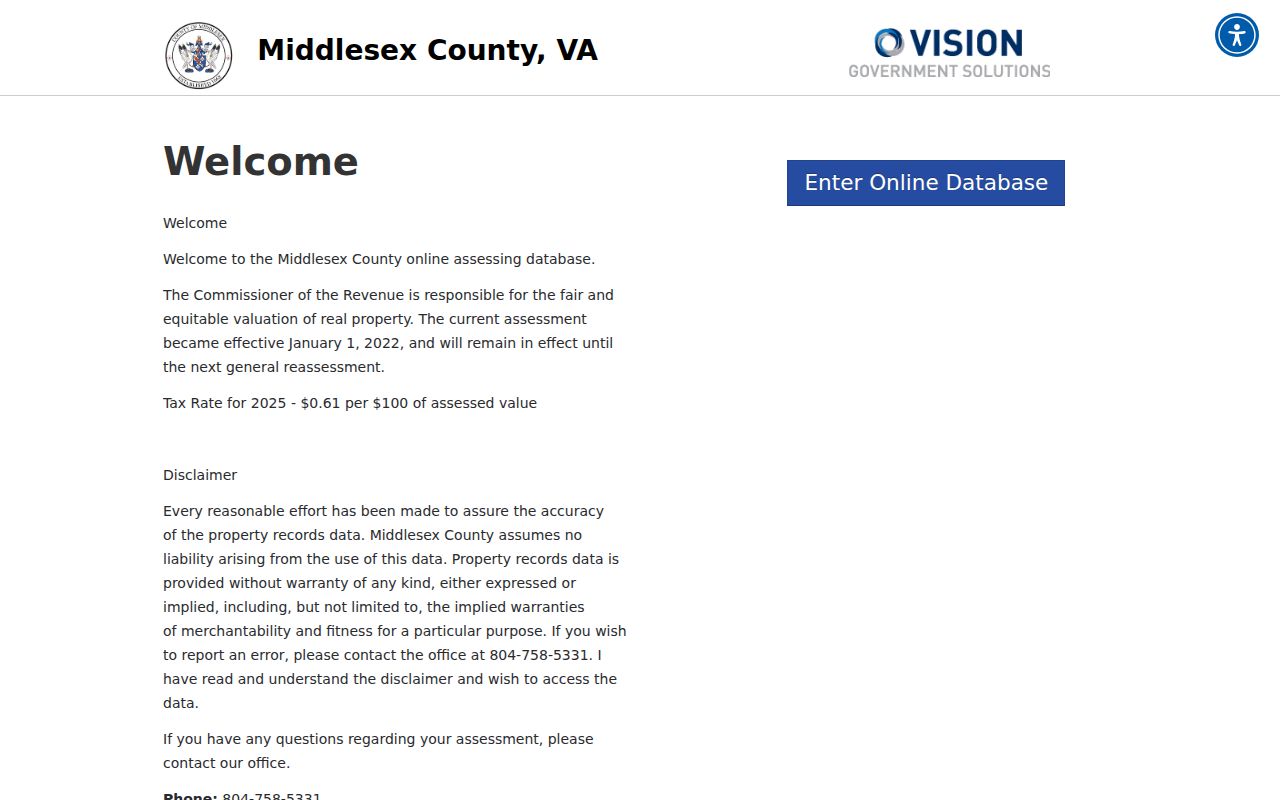
The countywide landing screen appears without a full parcel card.
Separate the Middlesex Situs from Mailing Address
A situs or E911 address marks the parcel's physical spot, while the mailing address receives tax and assessment notices. A mailing line can point to a post-office box, an entity's office, or somewhere outside Middlesex County. It says nothing about location. Nor does it prove who uses the land.
Two records may seem to conflict. Match the GPIN and legal description to confirm both screens describe the same land; a deed or plat carries that legal description. The county's addressing ordinance and E-911 & Mapping service add address context. A postal city like Urbanna or Saluda does not create a separate owner roll.
The split matters most in three cases. Think of a fresh transfer, a trust, or a parcel with a different tax-mailing destination. Each address answers its own question.
Entity Owners in Current Middlesex Records
A roll entry may name an LLC, corporation, business trust, estate, or trustee. Keep the capacity language from the deed. Shortening the owner to a person's name can distort the vesting. Virginia SCC CIS confirms a filed entity's legal name, status, registered agent, principal office, and document history. It cannot promise who controls a private company.
Estate and fiduciary transfers work differently. The owner field may show a representative or estate name until a proper deed or order records and the roll catches up. The public roll indexes current assessment administration. The recorded deed remains the document to inspect for how the grantee is vested.
The official entity search is the Virginia SCC Clerk's Information System.
The statewide entity result is a filing source, not a substitute for the Middlesex land instrument. The deed recorded here still governs.
Recent Middlesex Transfers and Current Names
A recent transfer sets three dates side by side. One is the deed's recording date, another the assessor's effective assessment date, and a third the Treasurer's bill or payment date. Each moves on its own office schedule. They rarely line up. No Middlesex source gives an exact interval for the owner name to change after a deed records.
Vision may still show an earlier name. Search the Clerk's latest land record. Compare the grantee, legal description, and any trust or estate capacity, then ask the Commissioner about a pending roll update. That approach keeps a portal mismatch from being read as an error or as proof of an unrecorded transfer.
The records room sits at 73 Bowden Street in Saluda. The Clerk's land-record page explains how the county classifies deeds and related instruments.
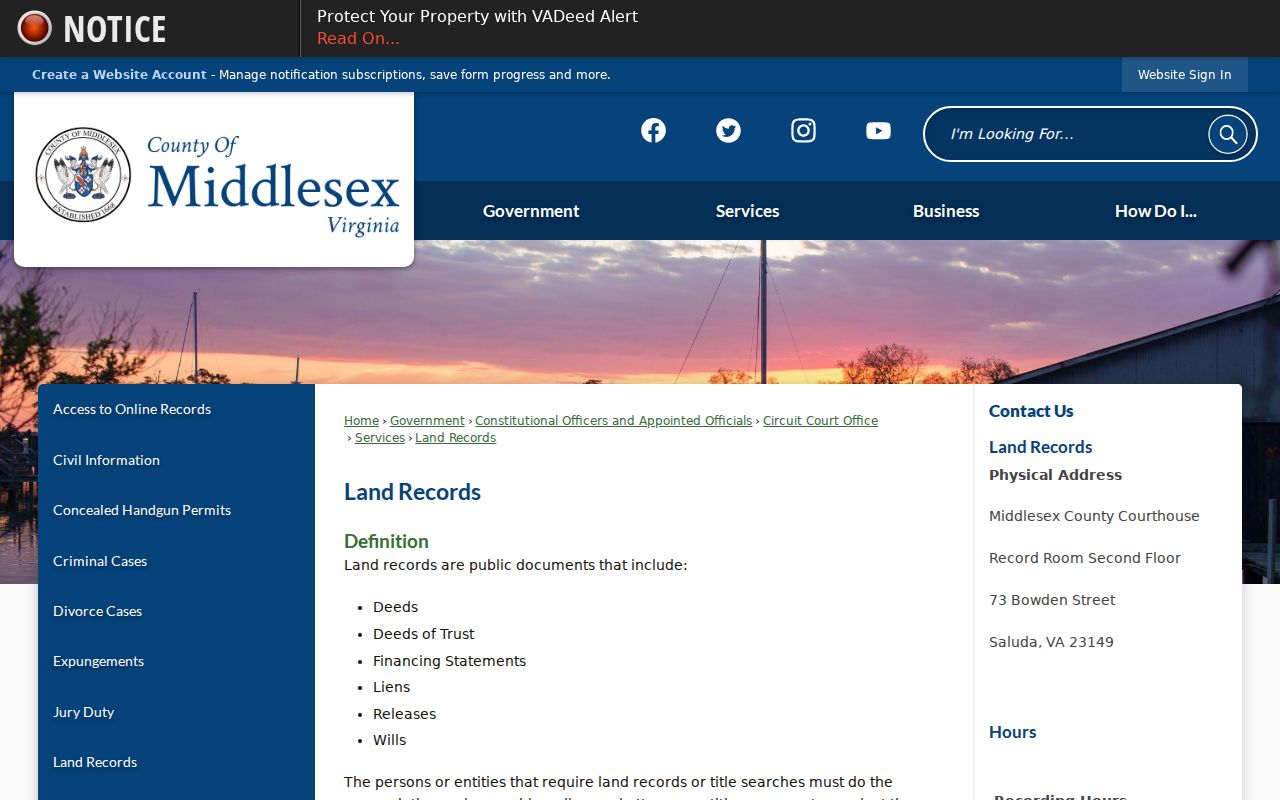
A current owner check turns on the latest conveyance, not just a parcel-card screenshot.
When to Request a Middlesex Certified Record
Vision works fine for casual parcel identification. A dispute, transfer, or estate is different. Those situations call for a certified copy of the recorded deed. That document carries the actual party and property language. The public records room is open weekdays from 8:00 a.m. to 4:00 p.m. Copies run 50 cents per page. Deputy-clerk certification adds $2 per document. Ask about the current total when a document has several pages. Other statutory charges may also apply.
Virginia SRA sometimes exposes a free index where the Clerk has enabled it. Viewing images takes more. Image access requires clerk authorization, a signed agreement, and applicable fees. Without remote access, request the instrument at the counter. You can also use a researcher who holds the right record reference.
The broader Middlesex owner-finding method starts with the address-to-owner route and its limits.
Check a Recent Middlesex Transfer Against the Roll
A freshly recorded deed deserves a cross-check. Compare the deed's grantee and legal description against the Commissioner of the Revenue's assessment entry. The county promises no update timeline. So don't assume both systems match on day one. The record date, the assessment date, and the online display date describe three different events.
After a recent purchase, start with the instrument reference in your closing papers or the Clerk's index. Confirm the instrument covers the same tract. That matters after splits, combinations, or older plat descriptions. Then pull the assessor record. Search by owner, situs address, or the parcel key on the county page. Old names linger. If the tax account still shows a former owner, ask the Commissioner which roll entry is current and ask the Treasurer about billing separately.
A deed filed after the roll's effective date can document a current transfer while the assessment page still lists the earlier roll owner. That timing gap is not a validity ruling. It never decides whether an instrument is legal. Use the Clerk for the recorded document and the Commissioner for the roll. For a legal ownership conclusion, turn to a title professional or an attorney.