
What Middlesex County Property Tax Records Show
Each office answers a different question. Vision carries the current assessment context and ownership administration, while e-Treasurer shows the tickets, balances, and payment history. Not every parcel-card field is published live. Confirm the current screen before treating a value or an exemption label as final.
| Field | What It Shows | Where |
|---|---|---|
| Assessed value | County valuation used to calculate property tax | Commissioner / Vision |
| Tax rate | Published charge per $100 of assessed value | County tax-rate page |
| Exemption or special assessment | Classification or use-based treatment that can affect the taxable amount | Commissioner / parcel record |
| Tax bill & status | Ticket, balance, payment history, or payment detail | Treasurer inquiry |
| Tax-deferral amount | Deferred taxes and interest that may form a lien | County program / account |
Read Middlesex County property tax records with the effective assessment date in mind. A posted value is not a live balance. It is not a recorded sale price or a market appraisal either.
Find a Middlesex County Tax Ticket
The Treasurer's e-Treasurer service searches real-estate tax records by account number, GPIN, or street name. The bill shows the account number at top left. For a GPIN search, the field is labeled Tax Parcel ID#. The spaces must be entered the same way. Street-name mode works best when you leave off the street number.
- Choose account, GPIN, or street-name search and enter the matching identifier.
- Use the optional projected date to recalculate penalty and interest; it defaults to the current date.
- Review matching rows; “Show Description” and “Show Map Number” add context, and numbered pages expose more results.
- Select a record to open payment history, then select a ticket for more detail.
- Assessed value
- The Commissioner's value for assessment purposes; it is not the balance due.
- Tax rate
- The county charge applied per $100 of assessed value.
- Tax deferral
- A program that postpones qualifying charges and interest under stated conditions.
- Tax lien
- A claim associated with unpaid or deferred tax under applicable law.
The Treasurer real-estate inquiry is the verified ticket lookup path.
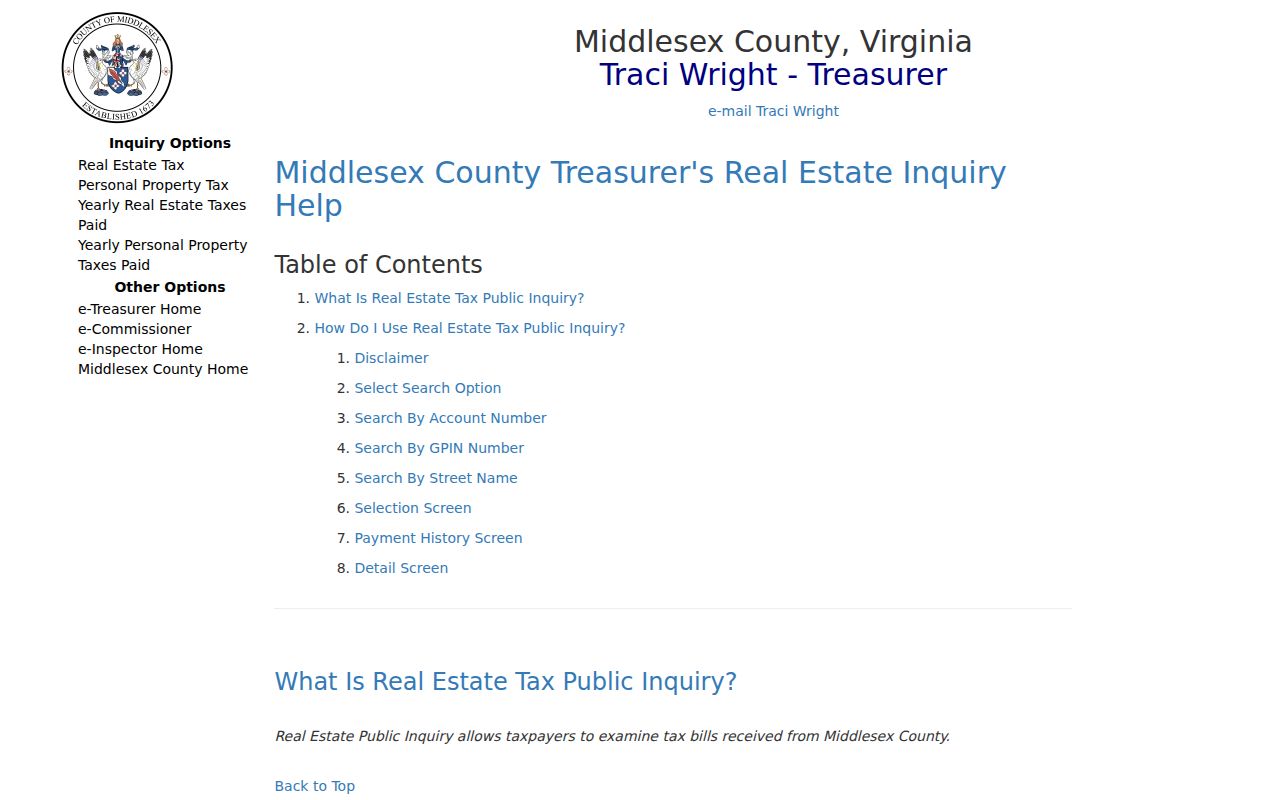
The e-Treasurer portal lists all three search modes. It also carries the ticket detail behind each match. After a search, the e-Treasurer payment-history page breaks out yearly-paid amounts and payment options separately.
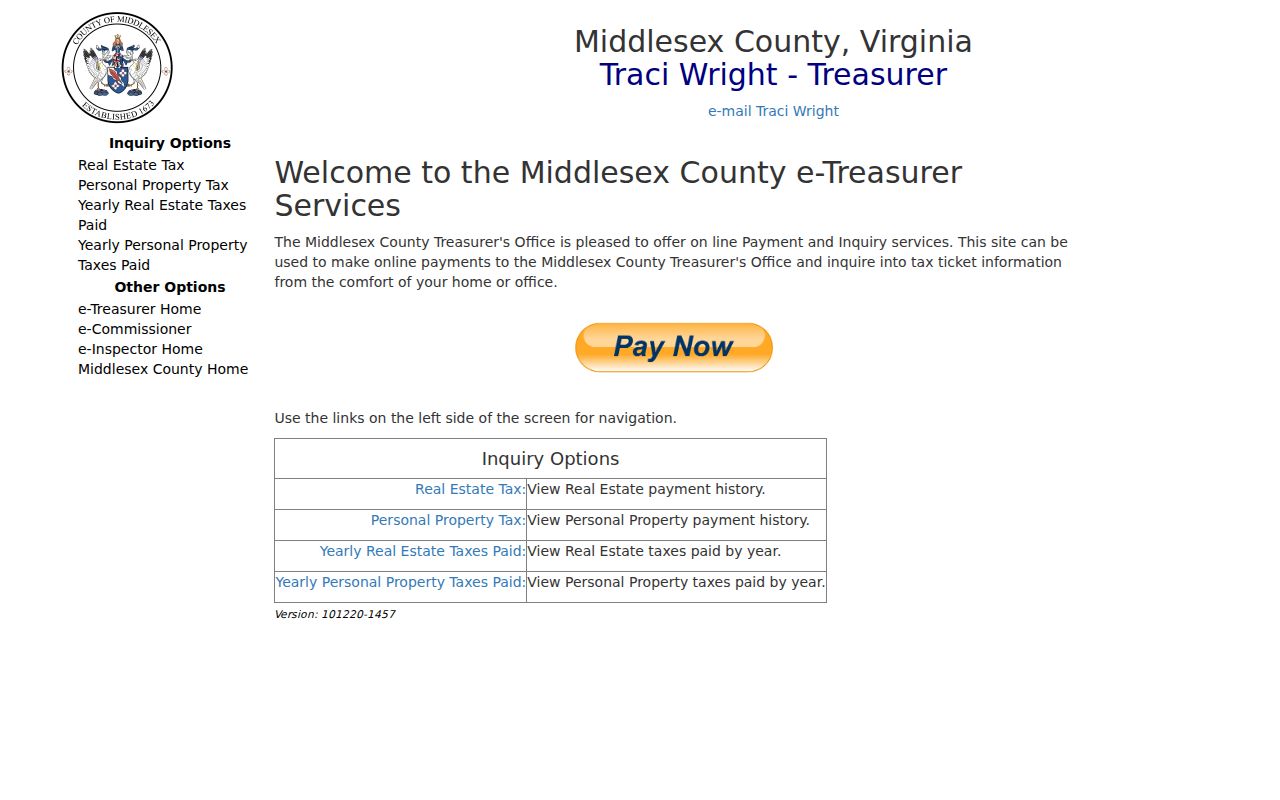
Payment history is a tax-account view, not a title record.
Appeal a Middlesex County Assessment
Start with the real-estate assessor. That office handles the first review of any Middlesex County assessment. Under the Board of Equalization ordinance, the assessor decides appeals before January 5 of the assessment year. The owner's notice supplies the filing deadline. Still dissatisfied? An application to the Board of Equalization is due before April 1 of that year. Check the current notice and ordinance for the cycle at issue.
Appeal timing. The county ordinance sets an assessor review before January 5 and a Board application before April 1 of the assessment year. Confirm the current notice before filing.
Middlesex County's $0.61 Tax Rate
Middlesex County publishes a 2025 real-estate rate of $0.61 per $100 of assessed value. The math is simple. Divide the assessed figure by 100. Then multiply by 0.61. Treat that as an illustration, not a promise about the final ticket. Exemptions, land-use treatment, tax relief, supplements, and exonerations can all shift the taxable base.
Vision lists January 1, 2022 as the effective date of the current assessment. It stays in effect until a general reassessment. The county has announced data gathering in 2026 for work tied to the next cycle. Public notices describe a 2027 data program. Keep assessment year, tax year, and payment date separate.
Check the official county tax-rate schedule and the Vision assessment portal.
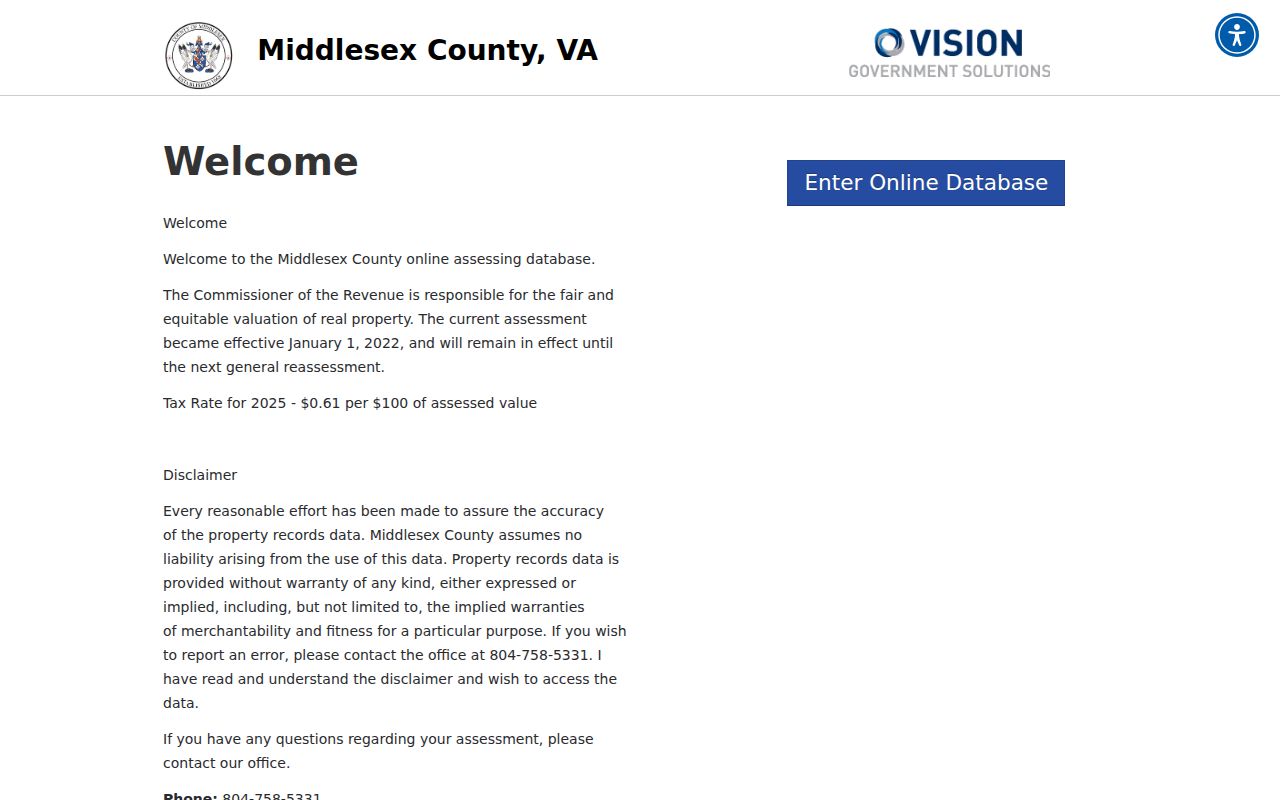
The countywide portal view is not a parcel-specific bill. Use the Treasurer's matching account or GPIN record for the amount due.
Middlesex Land-Use Assessment and Exemptions
The county FAQ puts both tax exemptions and special assessment programs under the Commissioner. Ownership alone decides nothing. A parcel is exempt under Title 58.1, Chapter 36 of the Virginia Code. That status comes only through classification or designation. The property owner's name does not make it so. The county may require an application or a supporting letter. Some designations also need Board of Supervisors approval.
Land-use assessment values qualifying agricultural, forestry, or horticultural land by its use. It does not rely on an ordinary market estimate. The break can be temporary. When a parcel leaves the program, the county may assess the difference for the current tax year. It may also reach back five prior tax years. That rollback matters. A lower use-based assessment is not always a lasting cut in the property's tax exposure.
Check current program status with the Commissioner. Then compare the parcel record against the county's assessment and exemption materials.
Middlesex Deferral Rules Can Follow a Parcel
Middlesex County runs a local real-estate tax-deferral program. It covers owners age 55 or older who held the same property in the prior year and whose tax rose more than 105% without a value-increasing change. Deferred taxes accrue interest. The ordinance makes the accumulated amount payable at sale or transfer. It is also due from the estate within one year after death. Either way, the amount is a lien.
This rule can follow a parcel. It matters when a ticket looks lower than expected. A property changing hands is another flag. A portal balance may not explain the full deferral history, so ask the custodian how the specific parcel has been treated and read the governing ordinance before assuming an old tax bill captures the whole obligation.
The County's real-estate tax-deferral document describes eligibility, interest, and repayment conditions.
Middlesex Assessment Appeals Use a County Form
Middlesex County's 2022 reassessment hearing form asked for a map number, owner name, phone, the current assessment, and the owner's opinion of value. It even offered an email-copy option. Those fields show what evidence the county wanted that cycle. Treat the form as a sample only. Start with the current appeal notice, and ask the Commissioner which submission route applies now.
The appeal schedule runs in two stages. The assessor reviews the initial appeal before January 5 of the assessment year. An owner still dissatisfied may apply to the Board of Equalization before April 1. The notice controls the filing deadline. No single deadline fits every notice date or later cycle.
Open the 2022 hearing form and the current Board of Equalization ordinance.
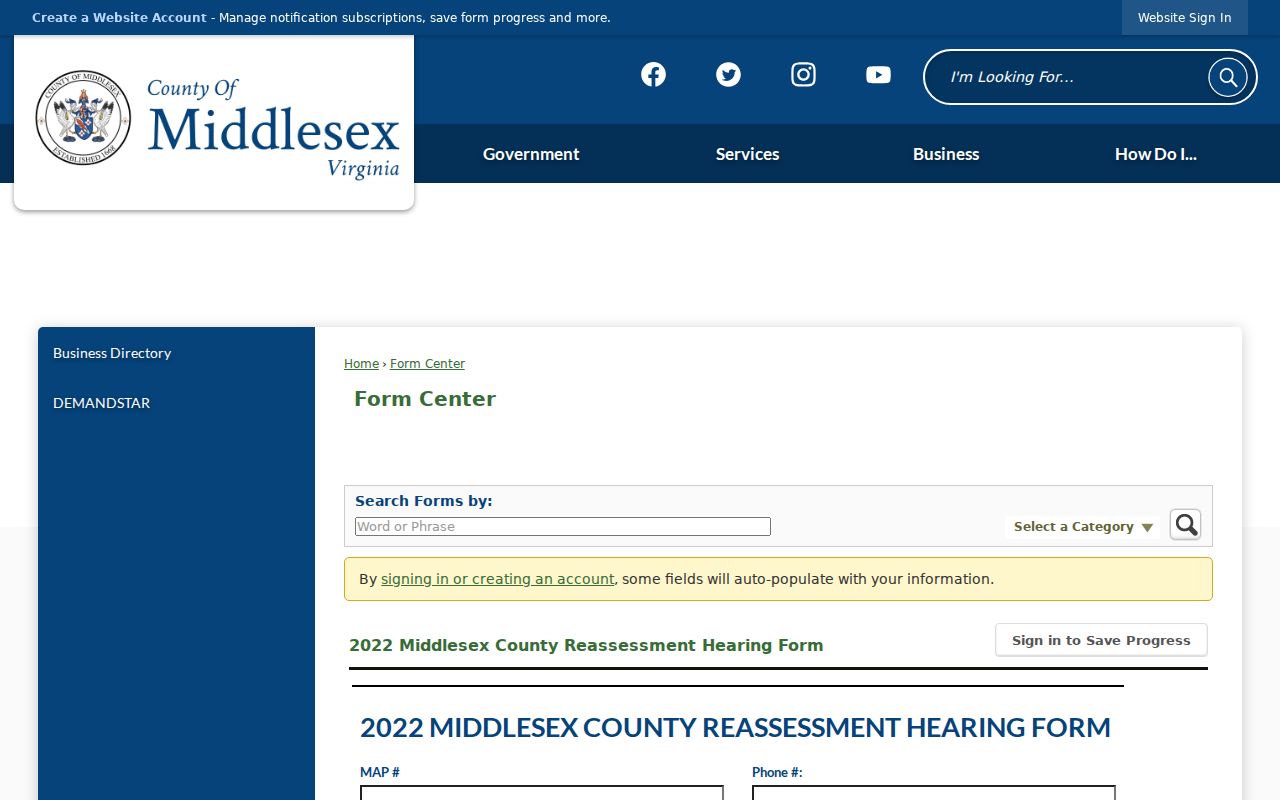
For filing and evidence, rely on the county's current instructions.
Delinquent Middlesex Taxes Need Direct Confirmation
A Treasurer inquiry is the starting point. It covers bill status and payment history. Middlesex County publishes no comprehensive delinquent-tax list, publication schedule, or redemption instructions. So ask the Treasurer directly for the current payoff amount and legal status. An unpaid ticket does not prove a sale listing.
Tax-sale decrees, foreclosure orders, lis pendens, and special-commissioner sales can also sit in Circuit Court case files and recorded land instruments. Search the statewide case portal by locality and party. Then request the file from the Clerk. Verify a completed sale through the final order and the later recorded deed. A notice or complaint alone settles nothing.
The county's 2026 e-check announcement concerns payment method, not delinquency or title, so keep a tax ticket, court order, recorded deed, and satisfaction as distinct documents.
Use the Middlesex Treasurer Ticket Controls Carefully
Match the search method to your identifier. The account number sits at the top left of the tax bill. The GPIN is the tax parcel identifier, and it must be entered exactly, spaces included. A street-name search should omit the street number. Results may be paged, so scan the list before assuming the first line matches your address.
The portal adds controls for a description or map number plus a selection step leading to payment history. Use those details first. Confirm the account before reading any balance. The optional Projected Date changes the date used to calculate projected penalty or interest, and the current date is the default. A projection is only a calculation for the date entered. It does not prove the later official bill.
Payment history opens through the county's eTreasurer real-estate page. That page includes yearly paid information and online-payment options. An online lookup and a posted payment are not always simultaneous, so a recent payment may still be processing. If a payment is missing, the account identity is unclear, or a projected total differs from a notice, contact the Treasurer with the account number or GPIN. Never guess from a similarly named parcel.